
Criminal Court Records in Fairfield County
A criminal court record begins when a criminal or motor-vehicle matter is filed in Connecticut Superior Court. The record is separate from the police arrest report and separate from a DOC custody profile. It is the court file that tracks the defendant, docket or case number, court location, charges, status, scheduled dates, plea activity, motions, disposition, and sentence. For the charge-focused path after an arrest, use arrest records and court charges; for custody status, use inmate records.
Fairfield County criminal matters are routed through Connecticut's Judicial Branch. Misdemeanors, arraignments, motor-vehicle matters, and many first appearances generally begin in geographical area courts such as G.A. 2 at Bridgeport, G.A. 1 at Stamford, G.A. 3 at Danbury, or Norwalk G.A. 20. Felony matters may begin in a G.A. court and move into a judicial-district Part A proceeding. Bridgeport, Stamford/Norwalk, and Danbury Judicial Districts are the key Fairfield-area Superior Court anchors.
How to Search Fairfield County Criminal Court Records
The main official path is the Connecticut Judicial Branch Criminal / Motor Vehicle Case Look-up. It links pending case searches by defendant or docket number, daily dockets by court or defendant, conviction searches by defendant or docket number, attorney and firm lookup tools, G.A. and J.D. court phone references, sentence review docket, motions to seal or close, and arrest warrants.
- Open the criminal/motor-vehicle lookup and choose pending case, conviction, daily docket, or docket-number search.
- Use defendant last name for pending searches, and add first initial, birth year, court location, or case type to narrow results.
- Select a Fairfield-area court location such as Bridgeport G.A. 2, Bridgeport J.D., Stamford G.A. 1, Stamford J.D., Danbury G.A. 3, Danbury J.D., or Norwalk G.A. 20 when known.
- Open the matching case to read status, next court date, charge category, disposition, or conviction data when displayed.
- Request certified copies from the Clerk of the Superior Court at the location where the criminal case was handled.
The criminal lookup page states that conviction information is generally displayed for no more than 10 years after sentencing unless Connecticut Practice Book section 7-13 provides a shorter period. It also states that youthful offender cases, juvenile cases, and infractions or violation convictions are not shown. Criminal history information can change daily because of erasures, corrections, pardons, or other modifications.
Pending Criminal Case Search
The manifest source for pending case lookup is the Judicial Branch pending criminal and motor-vehicle defendant search.
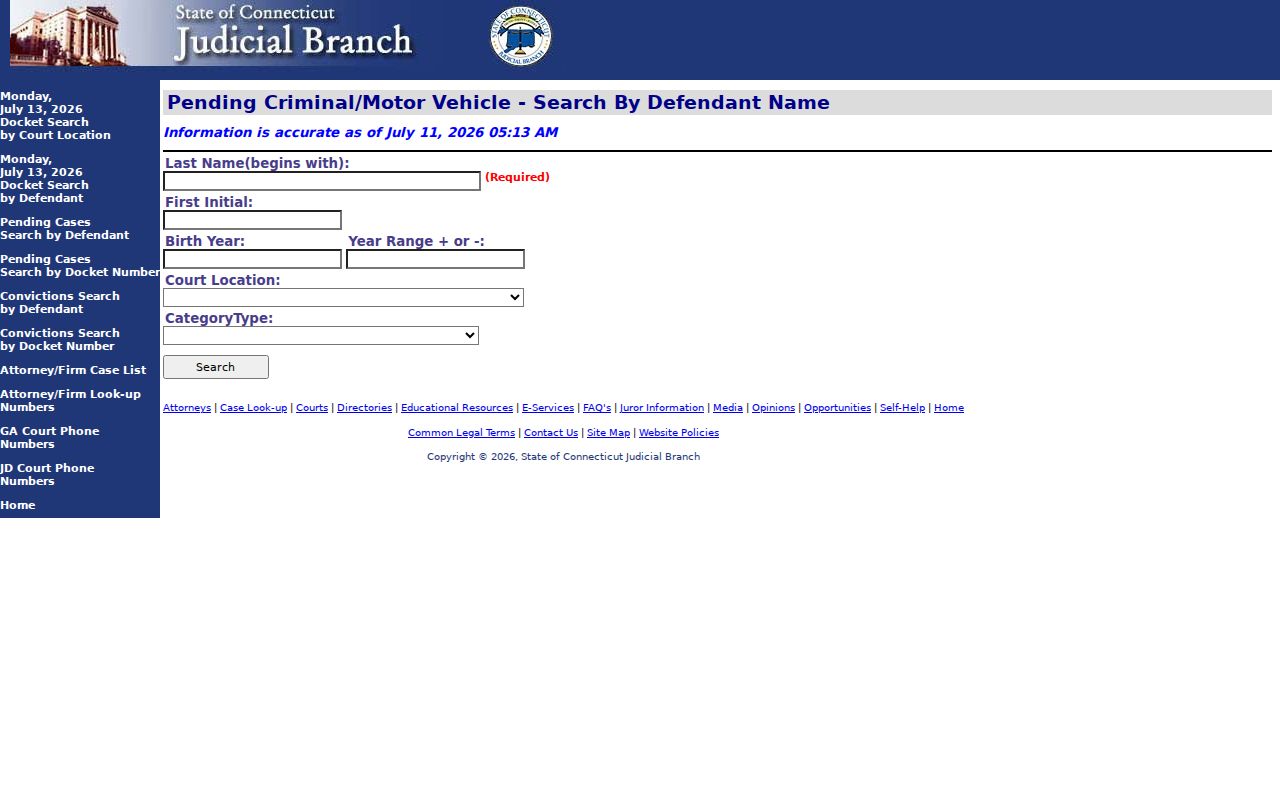
This search is most useful before disposition, when the question is whether a defendant has an open court matter, what court location is assigned, or when the next court date appears. It does not replace police records, DOC custody search, or a certified clerk copy.
Stages of a Criminal Case
Criminal records change as a case moves from accusation to resolution. An arrest may lead to booking and bond decisions, but the court record develops once a charging document and court docket exist. Arraignment is the first court appearance. Pretrial hearings and motions can address probable cause, discovery, suppression, bond, protective orders, diversion, plea discussions, or trial preparation. A case may end through dismissal, nolle, plea, verdict, sentence, or transfer to another status.
Case flow: Arrest or Summons › Charges Filed › Arraignment › Pretrial / Motions › Plea or Trial › Disposition › Sentencing
| Stage | What Happens |
|---|---|
| Arraignment | The defendant first appears, charges are addressed, bond or release conditions may be set, and the next court date is scheduled. |
| Pretrial / Motions | The parties litigate evidence, discovery, diversion, bond, continuances, sealing, and other case-management issues. |
| Plea or Trial | The defendant may enter a plea, proceed to trial, or reach another resolution allowed by court order. |
| Disposition | The court record reflects dismissal, nolle, guilty finding, not guilty finding, conviction, or other final result. |
| Sentencing | If there is a conviction, the record may show incarceration, probation, fines, costs, restitution, conditions, or sentence review activity. |
What a Fairfield County Criminal Court Record Shows
Public criminal detail typically shows enough information to identify the case and current public status. The display may include defendant name, docket or case number, court location, case type, charge or motor-vehicle category, pending status, next court date, conviction or disposition information when displayable, and daily docket details. Bond, probation, sentence, and restitution details may appear when part of the public case display, but exact access depends on the matter and court rules.
| Field | What It Shows |
|---|---|
| Case Number | The criminal or motor-vehicle docket identifier used by the Superior Court. |
| Defendant | The person accused in the criminal or motor-vehicle case. |
| Court Location | The G.A. or J.D. location handling the case, such as Bridgeport, Stamford, Danbury, or Norwalk. |
| Charges | The alleged offenses or motor-vehicle matters filed in court, which can change through amendment, dismissal, or plea. |
| Plea | The defendant's answer to a charge, if publicly displayed and applicable. |
| Disposition | The final or current result, such as conviction, dismissal, nolle, not guilty, or another court action. |
| Sentence | Post-conviction punishment or conditions such as incarceration, probation, fines, costs, or restitution where shown. |
Conviction Search and Display Limits
The official conviction-search source in the manifest is the Judicial Branch criminal conviction defendant search.
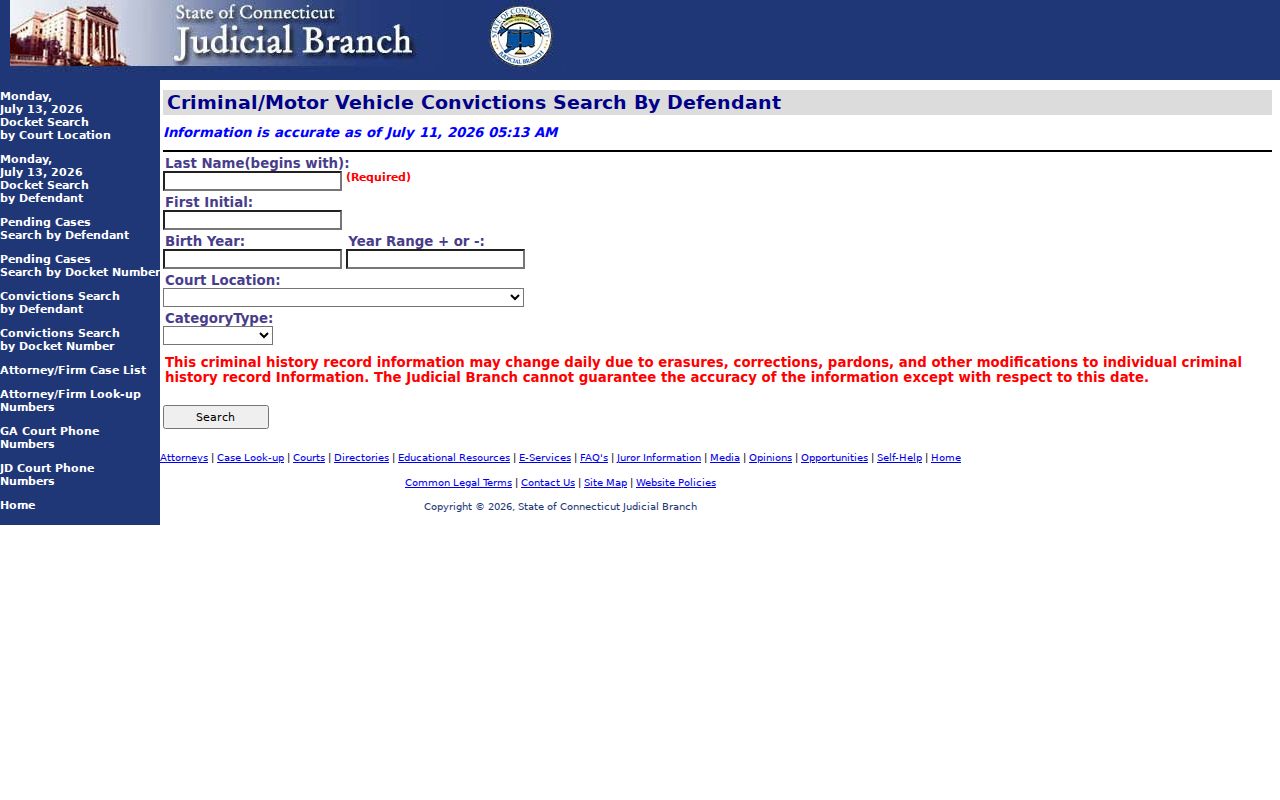
Conviction search is not the same as a complete criminal history report. Display periods, erasure, pardons, corrections, youthful offender status, juvenile confidentiality, and Practice Book rules can remove or limit what the public page shows. For official proof, request a certified disposition or judgment record from the clerk.
Charges vs. Convictions
A charge is an accusation filed in court. A conviction is a final result after a guilty plea, guilty finding, or other qualifying outcome. A criminal court record can show charges that were later dropped, dismissed, nolled, amended, reduced, or resolved without a conviction. That distinction matters for employment, licensing, housing, immigration, and personal-record review, and it is one reason certified dispositions are often needed.
| Charge | Conviction | |
|---|---|---|
| Stage | Accusation filed in court. | Final guilty result or qualifying judgment. |
| Proof Level | Based on charging standards and probable cause. | Requires plea, verdict, or court finding under criminal-law standards. |
| Public Record | Often public while pending, unless sealed, juvenile, youthful offender, or later erased. | Often public within display limits unless erased, pardoned, sealed, or otherwise restricted. |
State's Attorney and Public Defender Roles
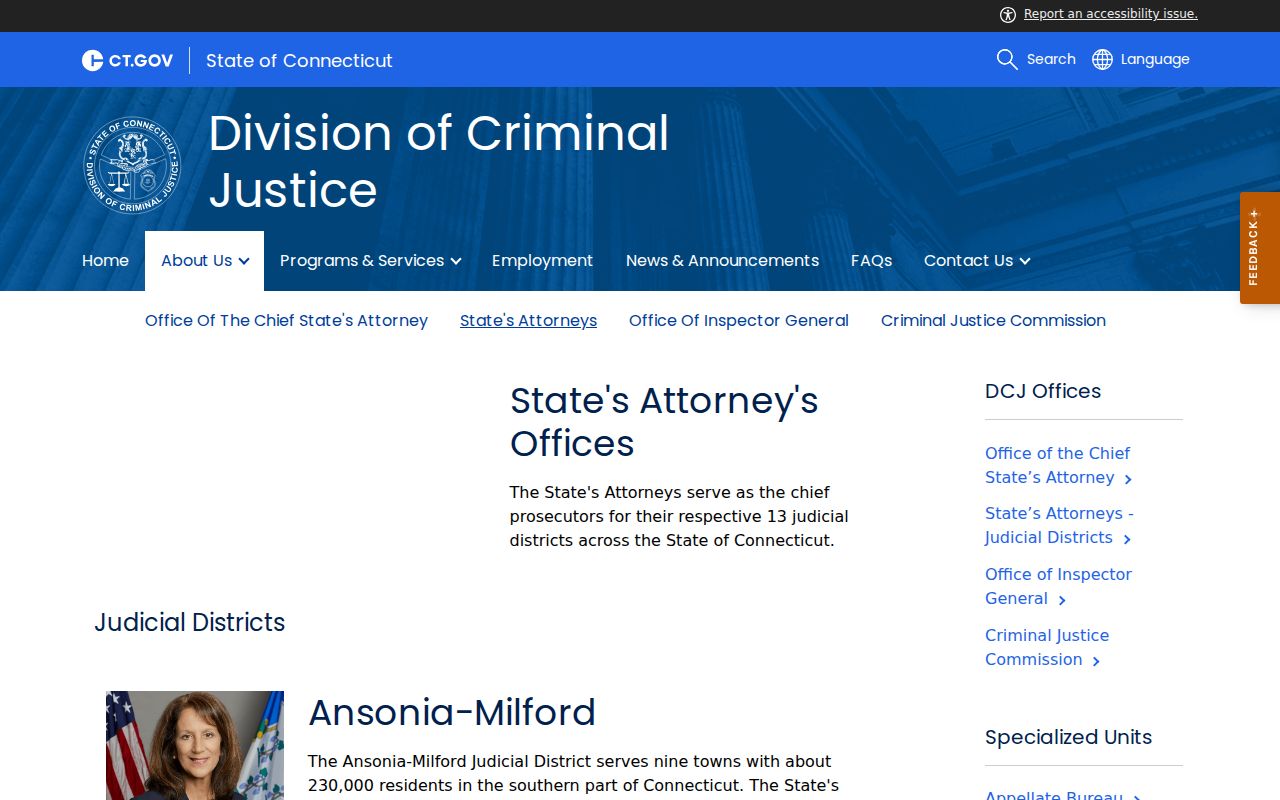
Connecticut uses State's Attorneys under the Division of Criminal Justice, not county district attorneys. The Bridgeport Judicial District State's Attorney is Joseph T. Corradino, and the research notes that his office covers six towns and cities in eastern Fairfield County including Bridgeport. Stamford/Norwalk and Danbury have separate State's Attorney district coverage. These offices prosecute offenses; they are not the clerk's office for record-copy requests.
The manifest source for the prosecutor directory is the Division of Criminal Justice State's Attorneys directory.
Public Defender Services offices are also court-location specific. The research identifies Fairfield J.D. Public Defender Services at 1061 Main Street in Bridgeport, Danbury J.D. at 146 White Street in Danbury, Bridgeport G.A. 2 at 172 Golden Hill Street, and Danbury G.A. 3 at 146 White Street. These offices may represent eligible defendants but do not serve as a public criminal records counter.
Sealed and Erased Criminal Records
Connecticut uses the term erasure for many qualifying criminal records. Conn. Gen. Stat. section 54-142a covers erased records, including many dismissed, not-guilty, nolled after waiting period, pardoned, or otherwise eligible matters. Erased records are not disclosed as ordinary public records. Sealing is different: it restricts access by court order or rule and may apply to a document, motion, proceeding, or whole file.
| Sealed | Erased | |
|---|---|---|
| Visibility | Restricted by court order, rule, or protected status. | Treated as non-disclosable under Connecticut erasure law. |
| Scope | May cover a document, proceeding, motion, or file. | Applies to qualifying criminal records after statutory conditions are met. |
| Public Search Result | May show limited information or no public document access. | May be removed from public display or not disclosed by the court. |
Public Access to Criminal Court Records
Connecticut public access starts with open-record principles but is limited by court rules and criminal-record statutes. Conn. Gen. Stat. section 1-210 provides public inspection rights for public agency records unless another law restricts access. Conn. Gen. Stat. section 1-212 addresses copies and certified copies. Conn. Gen. Stat. section 54-142a limits disclosure of erased criminal records.
Key point: A criminal case absent from public display may be sealed, erased, juvenile, youthful offender, too old for the online display, corrected, pardoned, or held in another system.
Background Check Considerations
Casual public searches and official background checks serve different purposes. A public court lookup can help identify court activity, but it may omit sealed, erased, juvenile, youthful offender, or display-limited information. A criminal history process may require fingerprints, identity verification, agency authorization, or a statutory purpose. Certified court dispositions from the Clerk of the Superior Court are often more reliable than screenshots when proving what happened in a criminal case.
Important: Public court lookup information should not be used for FCRA-regulated employment, tenant, credit, insurance, or eligibility decisions.