
Fairfield County Probate Court Scope
Connecticut Probate Courts are separate statutory courts, not divisions of the Fairfield County Superior Court. They handle decedents' estates, trusts, conservatorships, guardianships, children's matters, mental health commitments, intellectual disability matters, name changes, and related filings. A probate appeal may later appear in Superior Court as a civil case, but the original probate file stays with the Probate Court that served the town or matter.
That split matters in Fairfield County because probate districts do not follow a single county courthouse model. Bridgeport, Fairfield, Stratford, Trumbull, Northern Fairfield County, and Housatonic each have distinct probate coverage. A person in Fairfield and a person in Bridgeport may live close together but use different probate districts. Town clerks also remain separate for land and vital records, so marriage certificates and recorded deeds are not probate files.
The Connecticut Probate Court Case Lookup Tool is the starting point for public estate and trust searches. It is not a full replacement for a court file. The lookup can point to case data and district contact details, while copies, older files, and non-public matters still route to the local Probate Court.
Fairfield Probate Terms Defined
Probate filings use terms that show who died, who asks the court to act, who manages property, and whose rights may be affected. These terms help separate an estate case from a guardianship, conservatorship, trust, or appeal.
- Testator
- A person who made a will before death.
- Executor
- The person named in a will to carry out estate duties after appointment by the court.
- Intestate
- A death without a valid will, which can lead to appointment of an administrator.
- Guardianship
- A court arrangement for care or authority involving a minor or protected person.
- Conservatorship
- A Probate Court case appointing a fiduciary for an adult found unable to manage personal or financial affairs.
- Fiduciary
- A person trusted by the court to manage an estate, person, property, or trust.
Search Fairfield County Probate Records
The Probate Court Case Lookup Tool provides public case data from January 5, 2011 to present for decedent estates and trust matters, with incomplete data before that date. The research notes that a case-number link can show fiduciary contact information, while a district-name link points to Probate Court contact details. If the case is older, sealed, adoption-related, mental-health-related, or outside the tool's public categories, the next step is the local Probate Court.
The official probate case lookup page shows the search path for recent estate and trust records.
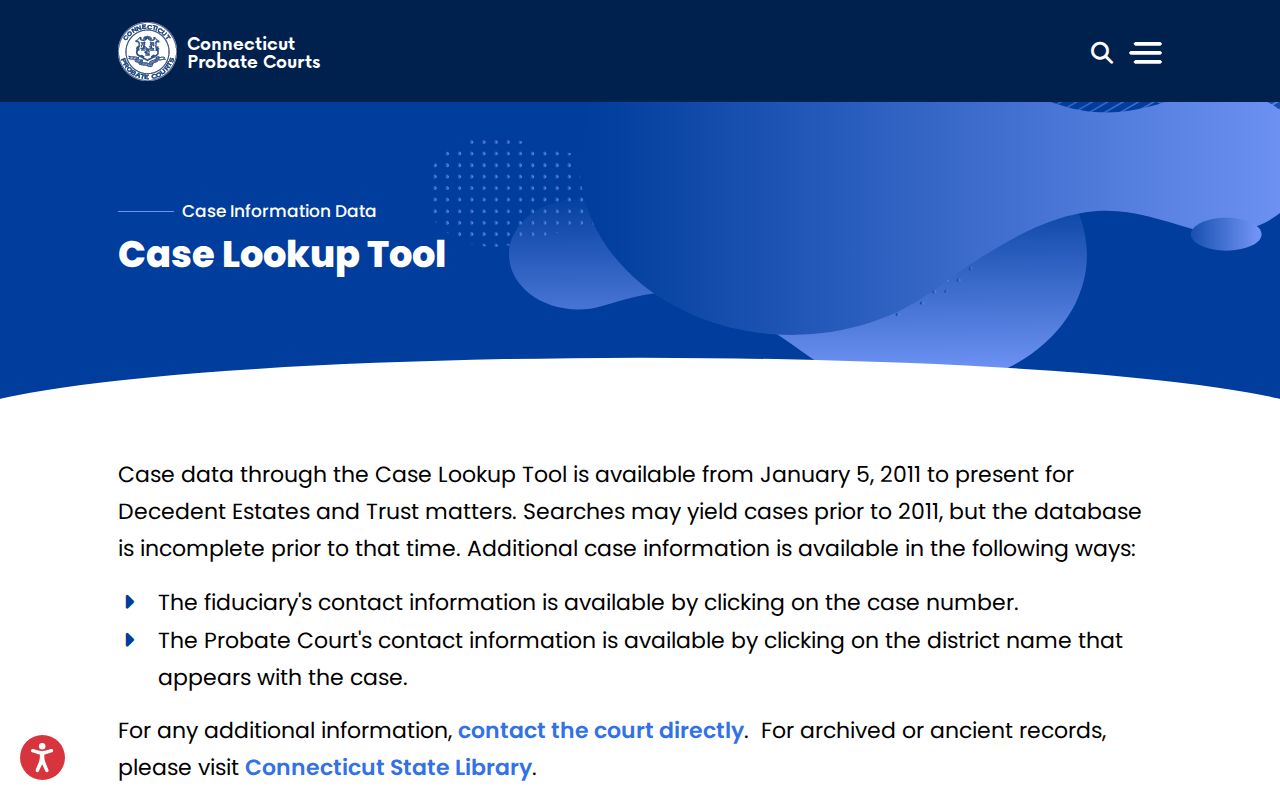
Use the lookup result as an index, then verify filing status, copies, and access limits with the district court before relying on the record.
- Identify the town tied to the decedent, trust, minor, protected person, or requested name change.
- Search the probate lookup by case name, decedent or trust name, district, or case number when known.
- Open the case-number or district link when available and note the probate district.
- Contact the district for certified copies, older files, non-public records, or documents not shown online.
| Field Label | Type | Required | Options / Format Notes |
|---|---|---|---|
| Case name / decedent or trust search | Text | No | Used for decedent estate and trust matters; exact labels should be checked visually. |
| Probate district | Dropdown or filter | No | Search or click the district name from a result. |
| Case number | Text or link | No | The case-number link may show fiduciary contact information. |
Note: Probate records missing from the lookup may still exist at the district court, especially older or restricted matters.
Fairfield County Probate Districts
The Connecticut Probate Court locator lists Fairfield-area court cards by district. Those cards matter because they name the judge, chief clerk, address, phone, fax, hours, and towns served. Use the town served column before sending a request.
The court locator displays Fairfield-area Probate Court cards and directs users to each district's contact information.
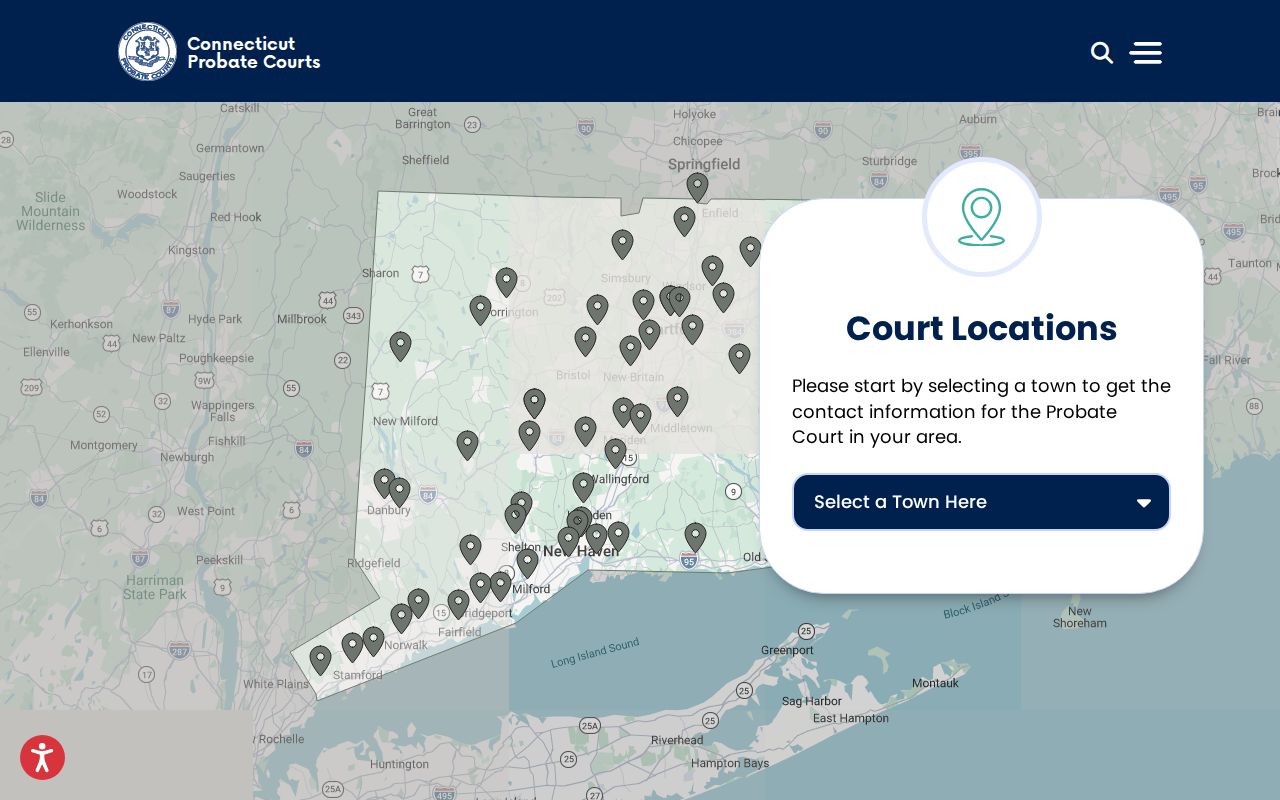
District boundaries are local. A countywide probate request can delay the search if the town belongs to a different district.
Northern Fairfield County Probate Court
1 School Street
Bethel, CT 06801
Judge: Steven Boa DeMoura
Chief Clerk: Jacqueline G. Buckle
203-794-8508
Mon-Wed 8:00-4:30; Thu 8:00-6:00; Fri 8:00-12:00
Bethel, Newtown, Redding, Ridgefield
Trumbull Probate Court
Town Hall, 5866 Main Street
Trumbull, CT 06611-5416
Judge: T. R. Rowe
Chief Clerk: Gail Hanna
203-452-5068
Mon-Fri 8:30-4:30
Easton, Monroe, Trumbull
Stratford Probate Court
468 Birdseye Street, 2nd Floor
Stratford, CT 06615
Judge: Max L. Rosenberg
Chief Clerk: Heidi Manente
203-385-4023
Mon-Thu 8:00-5:00; Fri 8:00-12:00
Stratford
Bridgeport Probate Court
Government Center, 999 Broad Street
Bridgeport, CT 06604
Judge: Paul J. Ganim
Chief Clerk: Lydia Tejera
203-576-3945
Mon-Thu 8:30-5:00; Fri 8:30-4:00
Bridgeport
Fairfield Probate Court
Independence Hall, 725 Old Post Road
Fairfield, CT 06824-6684
Judge: Katherine E. Caulfield
Chief Clerk: Diane Auray
203-256-3041
Mon-Fri 8:30-4:30
Fairfield
Housatonic Probate Court
47 Bridge Street
New Milford, CT 06776
Judge: Martin F. Landgrebe
Chief Clerk: Nanci Howard
860-355-6029
Mon-Wed 8:00-4:30; Thu 8:00-6:00; Fri 8:00-3:00
Brookfield, New Fairfield, Sherman and nearby towns
Fairfield Probate Estate Steps
Estate administration begins by finding the correct probate district based on the decedent's domicile or the matter type. The petitioner files the will if one exists, asks for appointment of a fiduciary, gives notice to interested persons, files inventory and accounting papers, handles claims and taxes, and distributes assets after court approval. The Probate Court Administrator guide states that estates must file an estate tax return in Probate Court within six months of death, and probate fees are calculated on estate value whether or not the estate is administered in Probate Court.
The Fairfield Probate Court page shows how an individual district publishes judge, chief clerk, address, phone, fax, and hours.
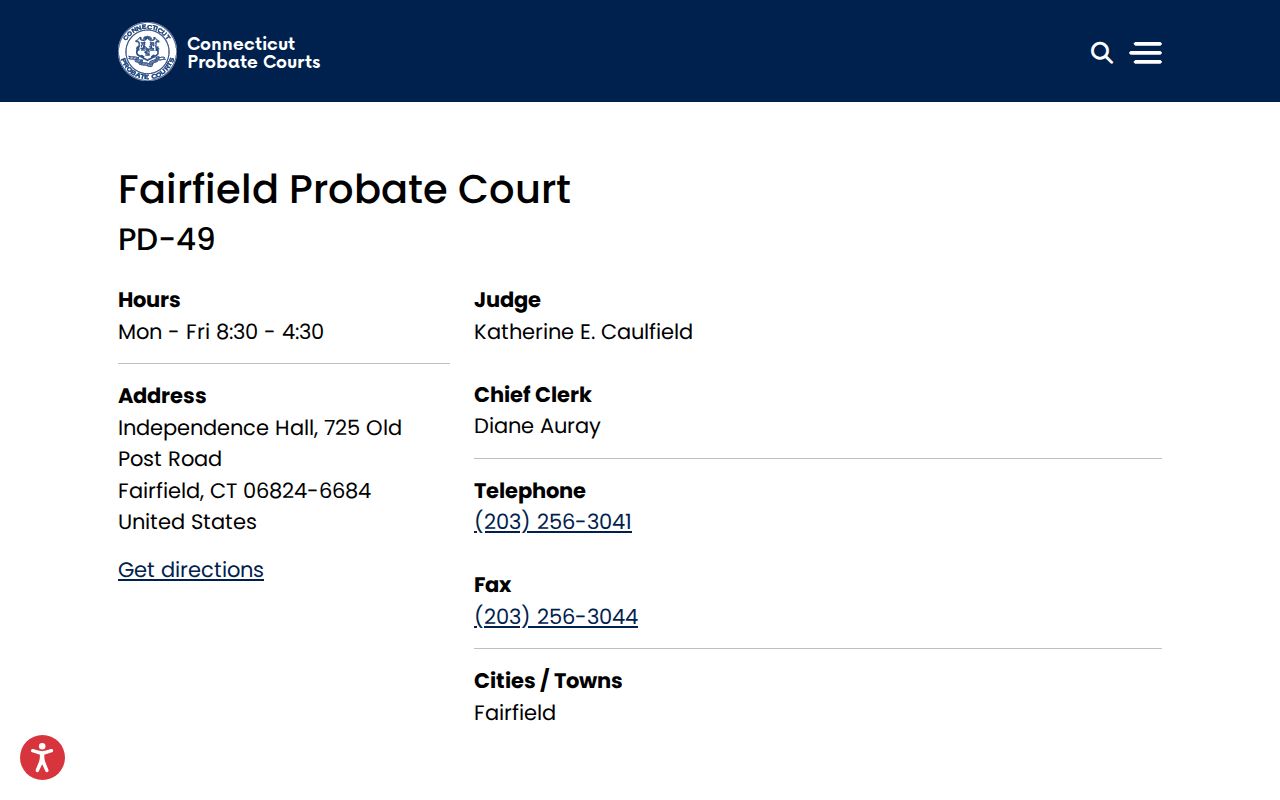
District pages are useful after a lookup result, because copy requests and file questions go to the court that holds the case.
| PC-200 Field | What It Identifies |
|---|---|
| Decedent name and domicile | The person who died and the probate district with jurisdiction. |
| Date of death | Timing for notices, estate tax return duties, and administration steps. |
| Petitioner information | The person asking the Probate Court to open or administer the estate. |
| Proposed fiduciary | The executor or administrator proposed to manage the estate. |
| Heirs and beneficiaries | People who must receive notice or may have estate rights. |
| Will, codicil, bond, signatures | Core filing details and acceptance of trust by each proposed fiduciary. |
Fairfield Probate Filing Channels
Connecticut Probate Courts support eFiling for initiating cases, filing documents in pending cases, serving documents on other eFilers, receiving notices, and viewing the court file. E-filing is useful for many probate matters, but it does not erase the need to pick the right district or comply with notice, tax, and fiduciary rules. Paper filings and local court contact still matter when a user cannot e-file or when a file is restricted.
The Probate eFiling overview describes case initiation, document filing, service on eFilers, notices, and file viewing.
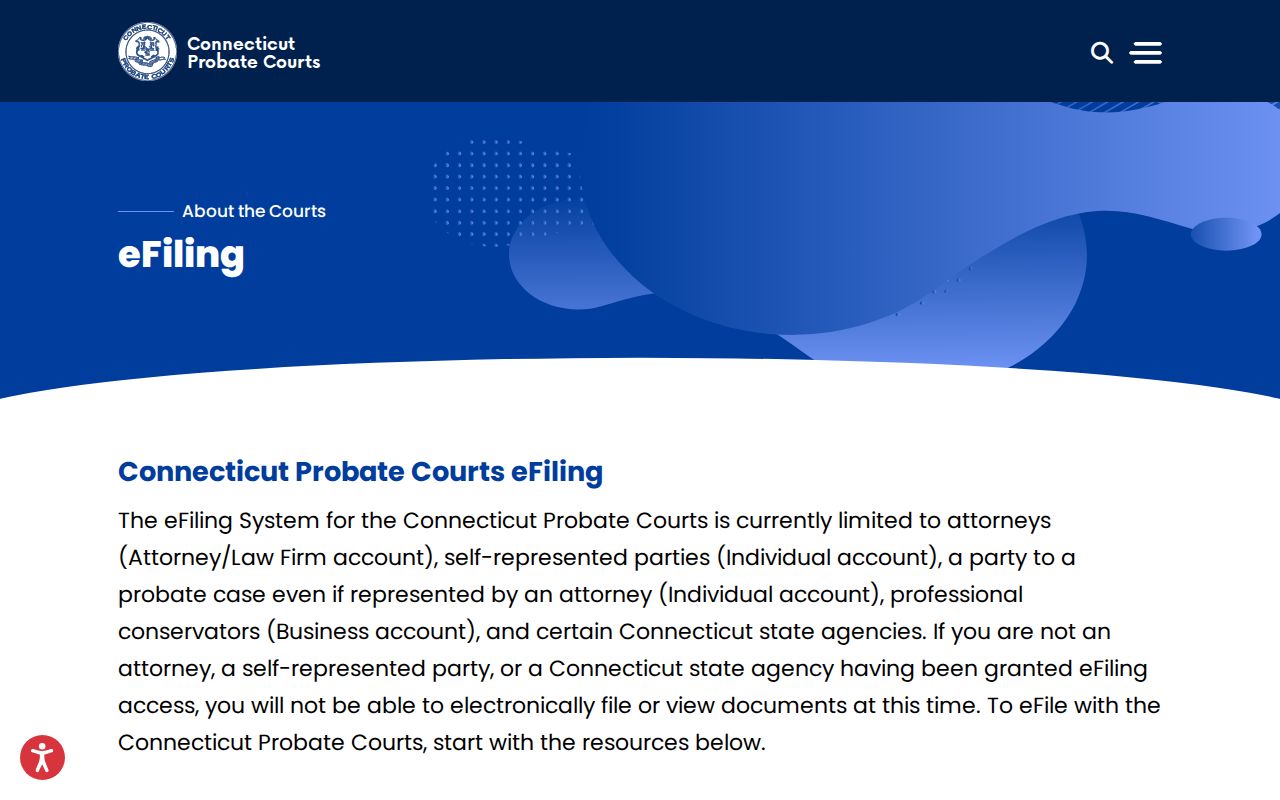
Before filing, match the eFiling action to the local probate district and confirm any fee or copy issue with that court.
| Probate Item | Fee / Access Note |
|---|---|
| Decedent estate filing | Use the Probate Courts fees and expenses tool or the local Probate Court; estate fees are calculated on estate value. |
| Estate tax return | The Probate Court Administrator guide says all estates must file within six months of death. |
| Certified or plain copies | Request from the local Probate Court that holds the file and verify the current copy cost. |
| Guardianship or conservatorship filing | Use Probate Court forms, eFiling guidance, and district clerk instructions for the matter type. |
Restricted Fairfield Probate Records
Not every Fairfield County Probate Court record is public in full. Adoption files are highly restricted. Mental health commitments, drug or alcohol commitments, electroconvulsive therapy, involuntary medication, some children's matters, and sensitive conservatorship materials can be limited because of medical, family, or privacy rules. Even when a docket or case exists, the court may redact personal identifiers, protected addresses, minor information, or financial account details.
For records that do not appear in the lookup, contact the probate district rather than assuming no case exists. The court can confirm whether the file is older, outside online coverage, restricted, sealed, or held under a different spelling or district. Probate appeals are different. Once an appeal is filed in Superior Court, the appeal record may appear in the civil case system, while the original probate file remains in Probate Court.